Rights for Nature: Building a European Movement

Emmanuel Schlichter
21 september 2026Dit artikel is Engelstalig.
Geschreven door: Emmanuel Schlichter en Charlotte Fuchs
The European Citizens’ Initiative (ECI) “Rights for Nature” is approaching an important milestone: on 13 October 2026, its EU-wide signature collection will officially begin. The initiative aims to collect one million statements of support over the course of twelve months, while reaching the required thresholds in at least seven EU Member States, calling on the European Commission to consider its proposal for the recognition of Rights of Nature at EU level.
To understand how the initiative has made its way to the corridors of European decision-making, we need to go back several months.
From a German idea to a European movement
The initial idea for the ECI emerged within Rechte der Natur e.V. in Germany. From the beginning, however, I felt strongly that this should not become a German initiative with European partners added afterwards. For me, the ECI was an opportunity to bring together the many Rights of Nature initiatives that already existed across Europe, support their national and local work and, at the same time, develop something new at the European level.
One country I particularly wanted to have on board from the very beginning was the Netherlands. I had followed the Dutch Rights of Nature movement and Jessica’s work for some time and found its development inspiring. What impressed me was not only how organised the movement was, but also how diverse: law and politics were part of it, but so were communities, art, culture and very different ways of connecting people with nature.
When Jessica agreed to become involved in the ECI, I happened to be in Brussels for an information day on European Citizens’ Initiatives. At almost the same time, the Stichting was holding its annual Rights of Nature gathering close to Amsterdam. So, I decided I had to make the trip. There were workshops and discussions, but also singing, poetry and many other ways of approaching Rights of Nature. With my rather poor Dutch, I unfortunately understood very little of what was actually being said. But the energy in the room needed no translation.
For me, this was an important moment. I saw how personal connections and a shared vision could bridge very different backgrounds and even language barriers. I also realised that building a European movement should not mean making all these different approaches the same. Quite the opposite: its diversity could become one of its greatest strengths.
Slowly at first and then with increasing momentum, the initiative grew into a network of lawyers, environmentalists, artists, academics and activists from across Europe. It’s a blessing to meet so many people who are determined to make a change for their ecosystems.
A European framework for Rights of Nature
At its core, the initiative seeks a European framework recognising the rights of ecosystems while empowering citizens and communities to represent and protect those rights in legal and political decision-making. We made sure that this is at the core of our initiative.
Rights of Nature is not intended to replace existing environmental law. Rather, it adds another perspective.
Traditional environmental law often asks what humans may do to nature and under which conditions. Rights of Nature also asks: what does an ecosystem itself need in order to survive, recover and continue functioning, and who should be able to defend those interests? But not only that, it seeks to empower citizens to stand up for these rights and the communities they live in.
In March 2026, we formally submitted the ECI to the European Commission under the title “Rights for Nature: Empower Citizens to Represent and Protect Ecosystems.” In May, the Commission registered it. Reaching this point, however, was only the beginning.
More than collecting signatures
Alongside strengthening the position of nature within European law, the initiative has a second important objective: creating broader awareness of Rights of Nature. Education and outreach are therefore central to what we are doing. The aim is not simply to collect signatures. We also want people to engage with the idea themselves and, possibly, become active for the ecosystems in their own communities.
Social media is one way of doing this. We use it to explain the concept, highlight environmental developments and share Rights of Nature initiatives from Europe and beyond. Events and personal encounters have been equally important. Mar Menor showed that human connections are the most powerful tool. The wonderful people from there show that we need to be fierce and always enjoy the process.
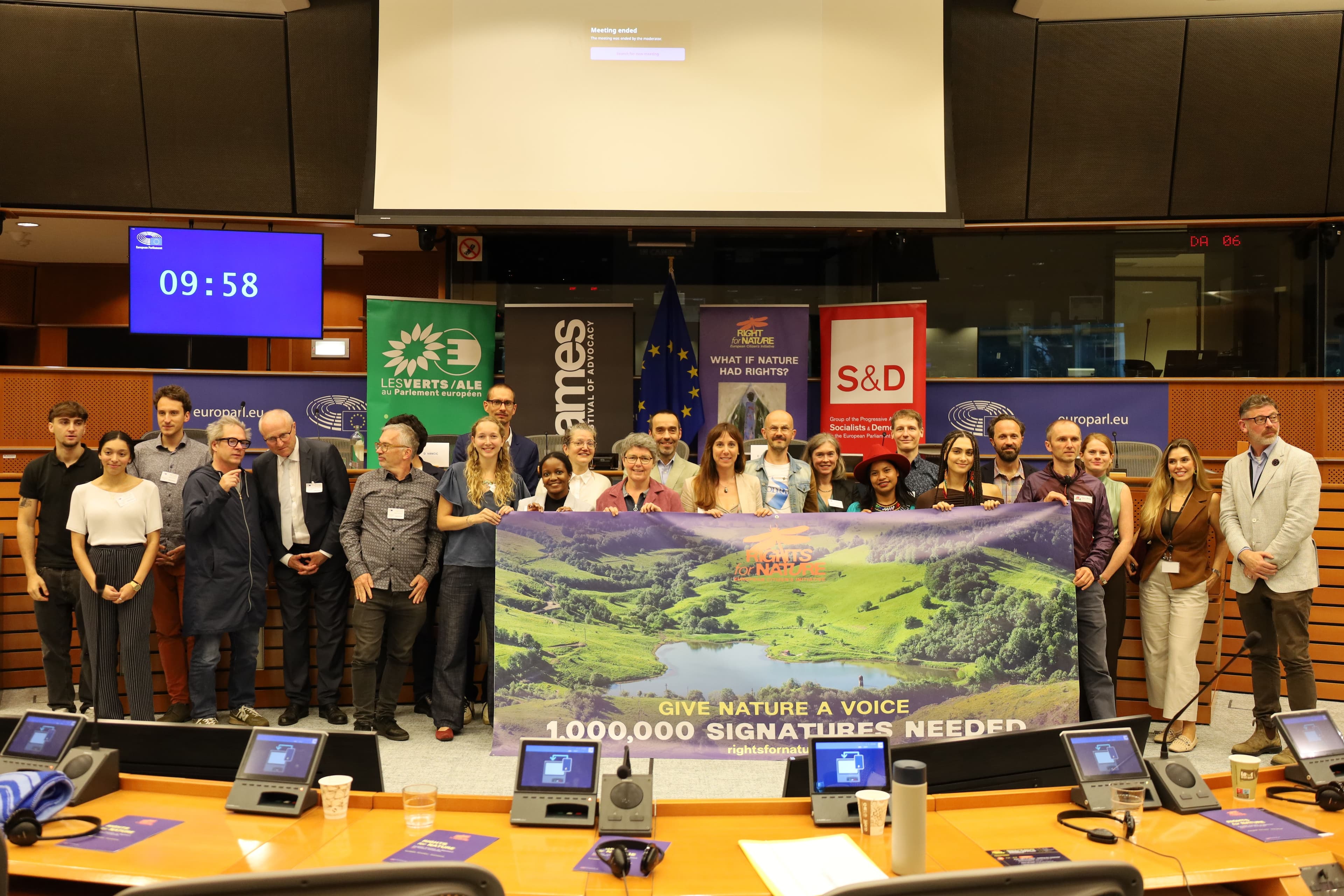
In March 2026, representatives of the ECI travelled to Strasbourg to present the initiative at the HEAR Rivers Festival. In July, we organised a conference in Brussels, bringing together ECI representatives and Members of the European Parliament.
Only last week, at the Confluence of European Water Bodies in Berlin, I met people working around the Dogger Bank in the North Sea. Once again, I was struck by the extraordinary diversity of this movement. A river in Poland, a marine ecosystem in the North Sea or a wetland in the Netherlands each comes with its own ecological reality, political history and community. There cannot be one single blueprint for Rights of Nature.
United by a common European umbrella
This brings us to what I see as a third objective of the ECI: bringing already existing initiatives together under a common European umbrella and creating opportunities for exchange, networking and mutual support.
This is also one of the biggest challenges. Coordinating a growing network across Europe takes time and resources. Different organisations have different capacities and political contexts. Arguments that resonate in Germany may not work in the Netherlands, Poland, France or Spain. A European initiative therefore cannot simply develop one approach and translate it into different languages.
What we can create is a shared framework that allows different initiatives to make it their own.
The initiative’s dragonfly has become a symbol of exactly that. It represents transformation and connects water, air and land, as well as old wisdom. The dragonfly is an invitation for the people fighting for the recognition of the Rights of Nature to use it as a common symbol. You can find it on our website and feel free to use it. We encourage you. Only if we are recognisable together across Europe can we show that we are a large, connected movement with the same goal.
One million statements of support
Now, all efforts are focused on the beginning of the signature collection on 13 October 2026. Reaching one million statements of support would require the European Commission to formally respond to the initiative, although it would not oblige the Commission to propose legislation.
But for me, the coming year is about more than reaching this formal threshold. When I think back to that gathering in the Netherlands or to meeting the people working on the Dogger Bank at the Confluence, I am increasingly convinced that the most interesting part of this process may be what happens beyond the central campaign. I can hardly wait to see how these different communities will shape the initiative, how they will bring Rights of Nature into their own contexts and how they will find their own ways of gathering support.
A shared question
Perhaps that is the most important lesson for me so far: a European Rights of Nature movement will not be built by making everyone follow the same model. It will be built by connecting a remarkably diverse group of people around a shared question: what does it mean to have a different relationship with Nature?
And that conversation has already begun. Let us spread the dragonfly together!
Thanks to Charlotte Fuchs for co-writing this article.
Laatste nieuws
Blijf op de hoogte van de laatste ontwikkelingen op het gebied van Rechten van de Natuur in Nederland en daarbuiten. En ontdek hoe jij kunt meedoen.